Monday, November 30, 2020

Media Theories


Claude Levi Strauss: Structuralism 

How different cultures are structured 

Binary- Two things which are the opposite of another 

Binary Opposition - two concepts presented in direct opposition of each other. Strauss suggested our world is based on this


Stuart Hall: Representation 

A reconstruction of the world. The way a media product constructs the world and aspects in it, like social groups, real life events etc. 


Everything we see in a media product is constructed 

  1. Who or what is being represented 

  2. How the representation is constructed with media language

  3. What ideology is presented about the group

  4. What is the societal impact on the group 


What Stuart Hall argued was that representations can construct society 


Captive audience - An audience that has to watch 


Richard Dyer - Role of stereotypes

  • An ordering process

  • A short cut (for producers)

  • A reference point (for audiences)

  • An expression of dominant societal values

Identity - the way we present ourselves to the world


John Berger - Men act, women appear

Liesbet Van Zoonen - Feminist Theory

Men's bodies and women's bodies are constructed in completely different ways in media products. Women's bodies are used to sell media products, the assumption is that the audience is heterosexual men.


 Paul Gilroy: Theories around Ethnicity and PostColonial Theory

Colonisation - a country forcing their rules and beliefs on another country 


Paul Gilroy argues that we have subtle racial prejudices in UK and that they are encoded in media products 


Hierarchy - A system that ranks individuals to who’s better than who


Steve Neale - Theories around Genre

  • Genre allows audiences to identify 

  • To sort and make sense of media industries 

  • Beneficial to producers to identify trends

  • Genres leads to a standardised product (identical products)

Neale believes genre is instances of repetition and difference. He suggests that texts need to conform to some generic paradigms to be identified within a certain genre - but also subverts these conventions so they don't appear identical.


Desensitised - we keep seeing something until it doesn't have an affect


Tzvetan Todorov - Narratology

narratives tell us so much about how societies are constructed 


Equilibrium - balance 

Todorov Story Structure

Establishment of Equilibrium 

Disequilibrium 

Partial restoration of Equilibrium/ New Equilibrium  

Albert Bandura - Media Effects

Hypodermic Syringe:

Injecting ideologies through media products


Passive model of audience behaviour


George Gerbner - Cultivation Theory

The idea that the more we watch a media product such as TV we will be cultivated by the contents. If we watch violent things, it will grow the idea that violence is acceptable


An advantage of the theory is that it’s better than the hypodermic syringe 


A disadvantage is that it only applies to people who use media products consistently 


Stuart Hall - Reception Theory

Prefered reading - the right reading of a text

Dominant reading - the audience agrees with dominant values and ideologies 

Negotiated reading - the audience generally agrees but disagrees with some aspects

Oppositional reading - the audience completely disagrees with what they see


An actor will have a contract which states the minimum screen time they are supposed to have


David Borwell - classical narrative cinema 

  • Spatial continuity - the audience always know where they are

  • Temporal continuity - the audience always know what order the events happen, and any flashbacks will be signposted 

  • Realistic - must not make reference to other films 


David Hesmondhalgh - The Cultural Industries 

Horizontal integration - where one company buys another company in the same sector to reduce competition. For example, Disney buying Pixar


Vertical integration - where a company buys up other companies involved in different stages of the production and circulation


Conglomeration - a corporation that consists of a group of businesses coming together dealing in different products and services


Curran and Seaton - Power and Media Industries

  • media is controlled by a small number of companies primarily driven by profit and power

  • Media concentration limits variety, creativity and quality

  • More socially diverse patterns of ownerships can create more varied and adventurous media productions

Sonia Livingstone and Peter Hunt - Regulation

the theory that media completely transformed how media is regulated


Textual Analysis of Print Adverts


Maybelline Advert

  • Enigma code of "Make it happen" creates the question "make what happen?" could also be left up to the viewers own interpretation of what they want to make happen
  • The model's face takes up half of the shot which draws more attention to her face and especially her lips because of the red lipstick she has applied
  • The other half of the shot is taken up by a rose and the lipstick itself to draw attention to the product itself
  • The shot makes use of lighting by having all the lipsticks have a shine on them making them look more pristine and high quality
  • The advert features different shades of red lipstick which the advert calls the "most passionate"
  • One of the lipstick is dripping which emphasises the "creamier feel" of the lipstick
  • The "New York" connotes the exciting lifestyle of living there
  • The "Make it Happen" is encouraging the audience to make something happen and that Maybelline makes you feel more confident in doing that
  • The choice of words to describe the lipstick: crispier, creamier passionate, sensational. These words were specifically chosen to make the product sound more attractive

Tide Advert

  • The woman is depicted hugging the tide pods packaging with hearts above her head which connotes she is in love with it and women are in love with it in general
  • The large red words are the first thing a viewer of this media product will probably read because of the way it is larger and a different colour from the other text
  • The woman is dressed like a stereotypical housewife from the 50s that would do all the housework such as cleaning and cooking
  • "Tide's got what women want!" connotes the fact that the target audience is females and this is further reinforced by the text at the top which suggests that only women buy this type of product
  • The primary audience for this advert is white women 

  • This comic book style may appeal to a secondary audience of young girls

  • The advert connotes sexism since there is no mention or depiction of men in the advert 

  • The women hanging up washing are using slang/informal language connoting that the advert is meant to be seen in a silly, informal way

  • The woman holding up the men’s trousers is symbolising that she is doing this for a man and she looks delighted to do it

  • Women are seen as childish with the lack of responsibility they have in this advert while men do the real work

  • Women aren’t as good as men is the ideology the advert is giving off 

  • The woman on the right mentions the brand name and the product name which is quite odd thing to do

  • The advert is polysemic - has a lot of possible meanings 

  • This advert has a extremely condescending mode of address 


Coca Cola Advert

  • Gives off a relaxing lifestyle because of the woman resting her head on the table and smiling

  • The woman has messy hair connoting she is care free

  • The advert could be aimed at women because the model is a woman

  • A difference from the tide pod is that the coca cola advert doesn’t use any text


Claude Levi Strauss: Structuralism 

How different cultures are structured 

Binary- Two things which are the opposite of another 

Binary Opposition - two concepts presented in direct opposition of each other. Strauss suggested our world is based on this


Dolce and Gabbana Advert

Binary Analysis

Fancy vs Street-wear 

Young vs Old 

Carefree vs Working 


Charity Advertising - Wateraid


Charity Advertising:

  • The purpose of them is to raise money for their cause
  • They emotionally manipulate you into donating
  • Direct mode of Address
  • Conventions in an advert include showing distressing scenes
  • Statistics of bad things
  • A specific request for donation
  • Directly positioned in the advert

NSPCC Advert:

  • Adverts like this are normally shown on daytime television because it is much cheaper
  • One of the primary audiences is old people, women, and unemployed/underemployed
  • Sound effects of baby crying over soft, sad music
  • Black and white colours connotes sadness
  • Little stories and the victims are named to make them seem more human
  • The group represented are children and they are represented as victims which is quite stereotypical
  • Builds up the assumption that if we don't donate then these children don't get help
  • We are being positioned as the abuser

Barnado's Advert:

  • Cockroach in baby's mouth symbolises poverty
  • The cockroach makes the audience feel bad
  • Babies in poverty don't get silver spoons instead they get cockroaches
  • This image creates the question of "Why is no one helping the baby?"


WaterAid TV Advert:


The established shot is England where it's raining which we can tell by the rain drops on the window whereas the image below is Zambia which is dry with no rain. This creates a binary opposition between the two images. 


The colour contrast between the start of the advert and top image. The start of the advert has very bland colours whereas the top shot has all kinds of bright colours like pink, blue, green for example. At the start of the advert she is alone with the stark contrast to the image where she is with others.

  • This is an unconventional charity advert 

  • Proairetic code of her smiling showing she is happy with them getting water 

  • Hermeneutic code answered because this shows that money being donated is helping 

  • Symbolic code of the song she is singing connotes positivity and happiness

  • Atypical/non stereotypical representation of an African person 

  • Her singing in english appeals to an english audience and they are far more likely to identify with her

  • The mise en scene of running water at the end is showing progression and establishes the idea of positivity 

  • The buckets being colourful anchors the audience that this is a positive advert because of the bright colours

  • The people are shown smiling connoting positivity

  • The sun shining connotes a happy, warm place 

  • This advert shows Africa as an escapist place 

  • A binary opposition of England which is connoted as a rainy, depressing place and Africa as a happy, sunny place 

  • The teenagers are represented as hard working in the advert which is an atypical representation since they are stereo-typically shown as lazy

  • This advert subverts the hegemonic norm that men do all the labour by showing women working in the field 

  • A much more complex representation of women than in the Tide advert

  •  The shots being focused on her face rather than her body humanises her instead of objectifying her

Kiss of the Vampire


  • The iconography mise en scene of the bats reinforces that it is a horror film and that it is a conventional vampire film 
  • Full moon which is a genre paradigm of a horror film
  • Creepy castle in the background reinforces the idea of a horror movie 
  • Stereotypically attractive women functions as a generic paradigm suggesting romance elements
  • Hybrid genre Romance Horror 
  • Bites on a woman neck, and exposed neck 
  • Low key lighting symbolises key themes of movie
  • selection of colours, depressing, bleak, and miserable 
  • Early 20th century late - 19th century setting highly conventional of horror films 
  • Produced by Hammer Studios - specialists in horror films 
  • Costume: revealing nightdresses
  • Title: "kiss of the vampire" - word kiss also carries romantic elements
  • Further anchored by the positioning of the women: sexual overtones
  • Frightened face of vampire: atypical and subversive representation of vampires
  • One of the main killers is a woman 
  • Enforces the hegemonic notion that violence is acceptable 
  • The mise en scene of a male vampire surrounded by women enforces the idea of his status, hegemonic patriarchy 
  • This poster is polysemic 
  • Non stereotypical representation of a male vampire 
  • Atypical representation of female vampire since she is shown as strong 
  • Violence is shown as good

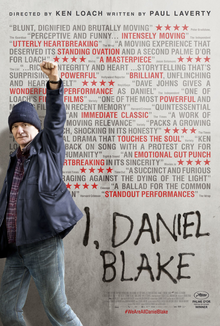
I, Daniel Blake


I, Daniel Blake (Loach, 2016)

What issues affect our society?

  • Racism 

  • Poverty 

  • Homophobia 

  • Climate change 

  • Police brutality 


Films don’t want to address these issues since it is harder to sell these films. They would be too political and controversial. People also use media as a form of diversion.


The Social Realist Genre

  • In these films, they explore issues that affect the most vulnerable in our society

  • They are typically set in North England 

  • Depict working class people as heroic 

  • Appeals to a niche and fragmented audience 

  • Anti establishment 

  • Rebellion against authority 

  • Include abuse

  • Deprivation in the working class

  • Anti British - attack the government and capitalism in general


Kes (1969)

  • A trouble making kid 

  • Has problems at school and at home 

  • Northern accents

  • Hints that something may be up with Casper 

  • Strict school 

  • Casper’s only form of escapism is his bird called Kes


The Selfish Giant (2013)

  • Kid gets excluded from school presumably for bad behaviour 

  • Northern accent 

  • Has a horse which he has a strong bond with

  • The kid does child labour for money 

  • The labour involves pretty dangerous jobs for a kid 


This is England (2006)

  • Kid gets bullied at school

  • Makes friends with a group of skinheads 

  • Finds a group which he can relate to 

  • Gets into all kinds of trouble 

  • Northern accents 

  • Deals with the issue of the unemployed 


  1. What makes the film an independent film?

  2. What genre is it?

  3. What specific issues does it focus on?

  4. In what ways are working class people shown to be heroic?

I, Daniel Blake (2016)

  • The trailer focuses more on the story rather than showing flashy scenes 

  • The trailer doesn’t really focus on promoting any of the actors 

  • It has themes of rebellion since it shows Daniel doing graffiti in protest to how the job system works 

  • It focuses on unemployment issues 

  • It also focuses on how people with medical conditions aren’t really cared for, his doctor deemed him unfit for work but he has to continue working to receive benefits

  • Daniel is shown to be heroic since he is shown standing up to the government essentially 

  • Talks about “non existent jobs” probably referring to shortage of jobs that accept someone with a medical condition or shortage of jobs in general

  • Issues of single parents having to provide for their kids but struggling to


Explain the ways in which social and political contexts may influence independent films. Refer to I, Daniel Blake to support your points


Dichotomy - same as opposites 


Capitalism - an economic and political system in which a country’s trade and industry are controlled by private owners for profit, rather than by the state


I, Daniel Blake Facts

  • Estimated to be around £2 million budget

  • 15.8 million USD box office 

  • Earned £445,000 in the opening weekend 

  • 94 cinema screenings 

  • The production companies are eOne Films, Why Not Productions, BBC Films, and Wild Bunch

  • It was distributed by BFI in the UK and Le Pacte in France 

  • Directed by Ken Loach who also directed Sorry We Missed You, The Wind That Shakes The Barley, and Kes

  • Stars Hayley Squires (The Miniaturist, In Fabric)

  • Stars Dave Johns (23 Walks, Fisherman’s friends)

  • Stars Sharon Percy (The Song of Names, School for Seduction)

  • Stars Briana Shann

  • Stars Dylan Mckiernan 

  • Stars Kate Rutter (Cotton Wool, The Full Monty)

  • Stars Kema Sikazwe (Lady Macbeth)

  • Got rated 92% critically on Rotten Tomatoes 

  • Rated 7.9/10 on IMDb

  • Rated 78% on Metacritic

  • Audience scored it 85% on Rotten Tomatoes 

  • Lots of positive user reviews on IMDb

  • Funded by BFI and BBC

  • Won multiple awards - Palme d’or, Prix du Public UBS, and more 


I, Daniel Blake Age Rating: 15

  • There is infrequent use of very strong language ('cunt'), as well as more frequent use of strong language ('fuck'). Milder terms include 'bastard', 'bullshit, 'wanker', and 'twats'

  • Other issues include visual and verbal references to prostitution

  • There are two notable scenes of emotional intensity. They include 'the food bank' scene and the ending 'funeral' scene

Exam Notes

 Component 1: Section A 2 mins per mark  Kiss of the Vampire comparison with unseen film poster  Media Language  Representation  Woman Magaz...